Why I Write Crime Fiction (And Why Birmingham)
It started in a bookshop.
Not just any bookshop — a tiny shop in Hay-on-Wye, the book town in Wales, that specialises in collectible crime and mystery. I was browsing the shelves when I noticed something about the old paperbacks. They were small. Pocket-sized. Designed to go with you — tucked into a jacket, slipped into a bag, pulled out on a train or a park bench or before bed.
That format said something. This is a book for living your life around, not for stopping your life to read.
I grew up around books like that. My mum read romance. My dad read westerns. Unpretentious, portable, entertaining. Then somewhere along the way, books got bigger. Thicker. Heavier. The kind you need a dedicated reading session and a strong wrist to get through. I’m not knocking those books — some of them are magnificent — but they’re not what I want to write.
I want to write the book you read before bed, or on a Sunday afternoon in the park. Something that tells a good story, respects your time, and doesn’t need a spreadsheet to track the characters. Small, sharp, satisfying.
That’s what drew me to crime fiction. Not because I want to win a Pulitzer — I don’t. Not because I’m making some grand statement about society — well, maybe a small one. Mostly because I want to write books I’d want to read.
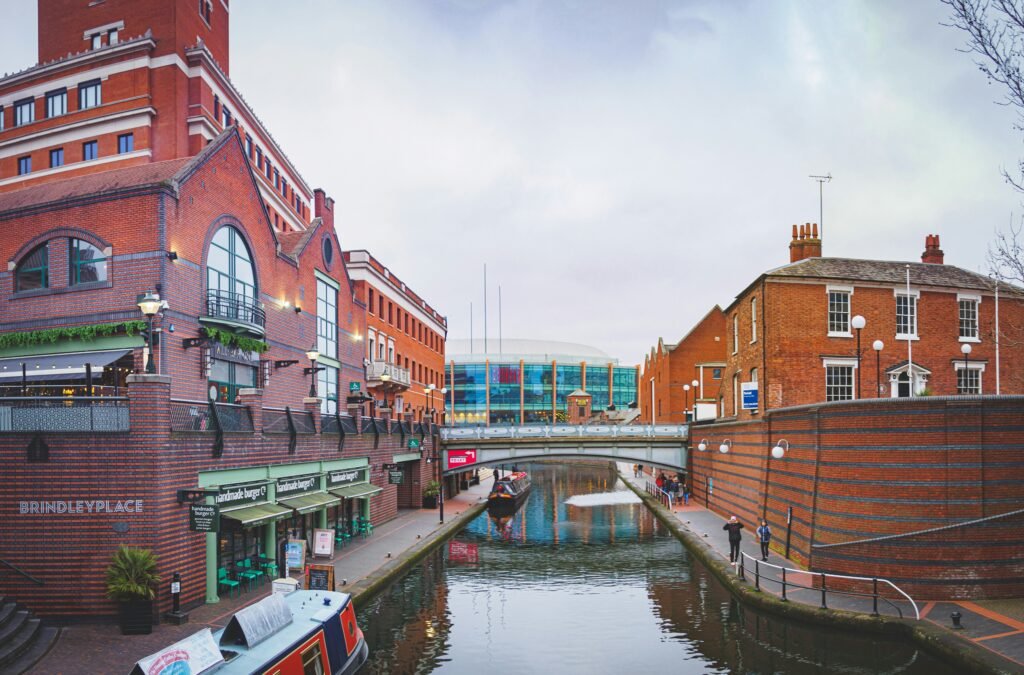
As for Birmingham — I live here. That’s the simple answer.
The slightly more complicated answer involves Ed McBain. When McBain was building the 87th Precinct series, he made a deliberate choice not to set it in New York, even though that’s clearly what it’s based on. The city in those books is fictional — he called it Isola. His reason was practical: if you use a real city, you have to get every detail right, and you never will. A fictional city gives you room to breathe.
I borrowed that idea. My Birmingham is a Birmingham — it looks and feels like the city I walk around every day, but I’m not beholden to every street name and postcode.
There’s something else, though. Before I moved here I lived in a village in south Wales. Quiet. Green. Space to think. Birmingham has never stopped feeling slightly claustrophobic to me — the density of it, the noise, the pace. I love what the city is. The diversity, the energy, the sense that something is always happening. But it presses in. I often talk about the ring road as a belt that is one notch too tight. Inside the ring road everything feels squeezed in tight. The character outside the ring road is different. There’s more space to breathe.
I hope that feeling comes through in the Ray Holder books. Birmingham in those stories isn’t a villain, but it’s never quite comfortable either. It’s a city that moves, and you either move with it or you get left behind.
That tension is really what I’m writing about. Ray Holder was a good cop — a genuinely good one — but circumstances have pushed him to the margins. He’s not doing what he was built for. He’s just getting by. And the city keeps pulling him back into the current, whether he wants it to or not.
I’m an Enneagram 1, if that means anything to you. Justice and fairness matter enormously to me — not in an activist sense, more in an observer sense. I watch. I notice when things aren’t right. I notice what happens to people who fall through the cracks while the city keeps moving.
That’s what Ray is. That’s why Birmingham. That’s why crime fiction.
The bookshop in Hay-on-Wye just gave me permission to start.